 1-877-581-3396


Debt Settlement vs. Bankruptcy: What New TransUnion Data Says About Credit Scores
Submitted by the Bond & Botes Law Offices - Tuesday, September 8, 2026
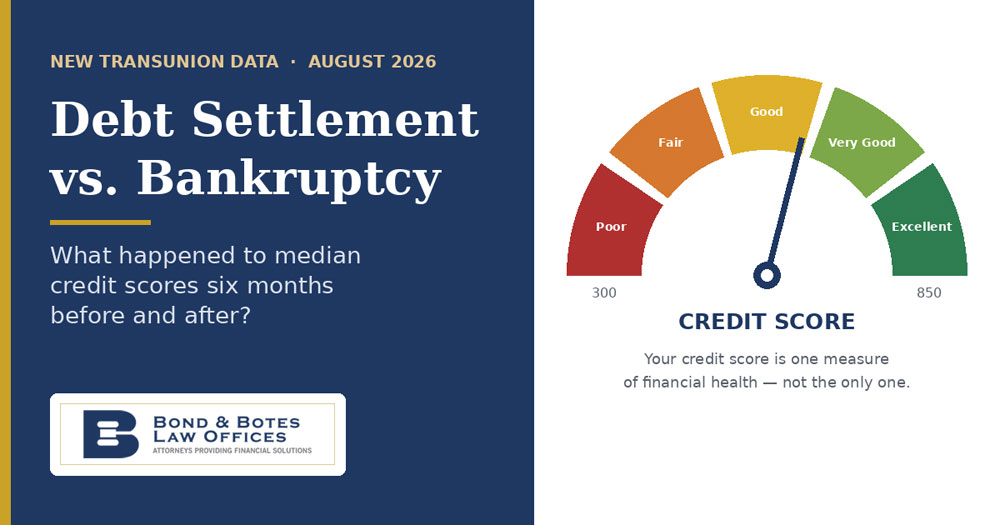
For years, consumers worried about bankruptcy have often looked to debt settlement as a possible alternative. New TransUnion data shows why the effect on credit deserves a closer look.
If you have ever thought, "I don't want to file bankruptcy because it will ruin my credit," you are not alone. It is one of the concerns bankruptcy attorneys hear most often.
Your credit matters. It can affect borrowing, housing and other financial decisions. So it is understandable that someone struggling with debt might look for the option that appears to cause the least damage.
New research released by TransUnion on August 27, 2026, provides fresh data comparing consumers who enrolled in third-party debt settlement programs with consumers who filed bankruptcy.
This research did not come from a bankruptcy law firm or a debt settlement company. It came from TransUnion, one of the major consumer credit reporting agencies.
The findings do not prove that one option will produce a particular credit result for every consumer. But they provide useful information for people deciding how to deal with serious debt.
What Happened to Median Credit Scores?
TransUnion examined credit behavior before and after consumers entered debt settlement or filed bankruptcy.
The largest difference reported was among consumers who were still current on their debts before entering debt settlement.
Their median VantageScore 4.0 was 645 six months before debt-settlement enrollment and 549 six months after enrollment — a 96-point difference between those two measurements.
For bankruptcy filers, the median score was 582 six months before filing and 562 six months after filing — a 20-point difference between those two measurements.
| Median VantageScore® 4.0 | Debt settlement — current at enrollment | Debt settlement — 30–90 days past due | Debt settlement — 120+ days past due | Bankruptcy filers |
|---|---|---|---|---|
| Six months before enrollment or filing | 645 | 623 | 573 | 582 |
| At enrollment or filing | 582 | 519 | 525 | 556 |
| Six months after enrollment or filing | 549 | 551 | 551 | 562 |
| Difference (six months before vs. six months after) | –96 | –72 | –22 | –20 |
Source: TransUnion analysis released August 27, 2026. Table created by Bond & Botes Law Offices using data reported by TransUnion. Difference compares the median score six months before enrollment or filing with the median score six months after enrollment or filing.
An Important Limitation to Understand
These numbers do not mean that filing bankruptcy causes less credit damage for every person.
The groups did not begin at the same credit score.
Consumers who were current when entering debt settlement had a median score of 645 six months before enrollment. Bankruptcy filers had a median score of 582 six months before filing.
That difference matters.
Many people who ultimately file bankruptcy have already experienced missed payments, high credit utilization, collection activity or other financial problems before filing. Some of the damage to their credit may therefore have occurred before the bankruptcy case began.
The TransUnion figures should not be treated as an apples-to-apples experiment proving that bankruptcy will always produce less credit damage.
But the findings still raise an important question:
If you are choosing debt settlement primarily because you believe it will automatically protect your credit better than bankruptcy, is that assumption supported by the facts?
TransUnion's findings suggest consumers should examine that question carefully.
Many Debt Settlement Enrollees Were Still Current
TransUnion reported that more than half of all debt settlement enrollees were current at the time they entered a program.
TransUnion also reported that consumers who were current before entering debt settlement showed increasing credit balances and utilization before enrollment. Among that group:
- Average credit card balances rose from approximately $7,112 to $14,547 during the two years before enrollment.
- Credit utilization increased from approximately 51% to nearly 78%.
- Average personal-loan balances rose from approximately $12,404 to $19,969.
- Within six months after enrollment, TransUnion reported that roughly half of those consumers' credit cards had closed.
This illustrates something important: you can still be current on your monthly payments while facing a debt problem that is becoming increasingly difficult to manage.
Many debt settlement programs involve stopping or reducing regular payments to creditors while money is accumulated for possible settlements.
Missed payments can affect credit, and creditors that have not agreed to a settlement may continue collection efforts permitted by law.
Credit Score Should Not Be the Only Question
Consumers understandably ask: "Which option will hurt my credit?"
But that may not be the most important question. A better question may be: "Which option gives me the best path toward actually solving my financial problem?"
Here are five questions worth considering.
Will the process actually resolve my debt?
Debt settlement generally depends on creditors agreeing to proposed settlements. A creditor generally does not have to participate in a private debt settlement program or accept a particular offer.
Bankruptcy is different. It is a federal court process governed by bankruptcy law.
What will I actually have to pay?
A debt settlement program generally requires you to fund settlements with your own money and may also involve fees charged by the settlement provider.
For someone who qualifies for Chapter 7, many qualifying unsecured debts may be discharged without requiring the consumer to spend years funding individual settlements with those creditors. That makes the total amount of money required to resolve the debt an important part of the comparison — not just what happens to a credit score.
That does not mean Chapter 7 is free or appropriate for everyone. Bankruptcy involves court costs, attorney fees and legal requirements, and the result depends on the consumer's individual circumstances.
The important comparison is not simply the advertised monthly payment. Ask: How much money will I have paid when this is over? And: How much debt will I still have?
Can creditors continue collection activity?
Private debt settlement does not automatically provide the same legal protection as filing bankruptcy.
When a bankruptcy case is filed, the automatic stay generally stops most creditor collection activity while that protection applies.
There are exceptions, and the effect of the automatic stay can depend on the circumstances and prior bankruptcy cases.
How long will this take?
Debt settlement programs may extend over several years.
A typical Chapter 7 case is often completed within approximately four to five months.
Chapter 13 works differently and generally involves a court-supervised repayment plan lasting three to five years.
Where will I be when the process ends?
Don't look only at the number on your credit report. Consider:
- How much debt will be left?
- How much money will I have spent?
- Will creditor lawsuits or collection activity have been resolved?
- Will I still have my home or vehicle?
- Will I be able to start saving?
- Has the underlying financial problem actually been solved?
A credit score is important, but it is only one measure of financial health.
What About Chapter 7 Bankruptcy?
Chapter 7 is one type of consumer bankruptcy.
For someone who qualifies, Chapter 7 may allow many qualifying unsecured debts — such as credit cards, medical bills and personal loans — to be discharged without a repayment plan.
A typical Chapter 7 case is often completed within approximately four to five months.
Filing also generally activates the automatic stay, which stops most collection activity while that protection applies.
Chapter 7 is not right for everyone. Income, assets, exemptions, prior bankruptcy cases, secured debts and the types of debt involved can all affect whether Chapter 7 is available or appropriate.
Learn How Chapter 7 Bankruptcy Works
What About Chapter 13 Bankruptcy?
The choice is not simply debt settlement or Chapter 7.
Chapter 13 is another form of consumer bankruptcy. Chapter 13 may allow an eligible consumer to reorganize debts through a court-supervised repayment plan that generally lasts three to five years.
It can be particularly important for someone who needs to:
- catch up missed mortgage payments;
- address a threatened foreclosure;
- catch up vehicle payments;
- protect property;
- deal with certain tax or other debts; or
- address financial circumstances in which Chapter 7 may not be the best option.
The amount someone pays through Chapter 13 depends on income, expenses, assets, debts and other circumstances.
Learn How Chapter 13 Bankruptcy Works
What Should You Ask Before Signing a Debt Settlement Agreement?
Before enrolling in a debt settlement program, ask for the entire proposal in writing. Then ask:
- Which creditors are expected to participate?
- Are those creditors required to accept a settlement?
- What happens if a creditor refuses?
- Will I be instructed to stop making regular payments?
- Can creditors continue collection activity or sue me?
- What fees will I pay?
- How much money will I have paid when the program ends?
- What happens if I cannot complete the program?
- Could forgiven debt have tax consequences?
- What would Chapter 7 look like for me?
- What would Chapter 13 look like for me?
- What other alternatives should I consider?
Bankruptcy Is Not Automatically the Right Answer
None of this means bankruptcy is right for everyone. It isn't.
Some consumers may be able to resolve financial problems through direct repayment, creditor hardship arrangements, nonprofit credit counseling or debt-management plans, negotiated settlements, or other approaches.
The important thing is to understand and compare your available options before committing significant income — or several years — to a particular program.
Related Bond & Botes Debt Settlement Resources
If you are considering debt settlement, you may also find these Bond & Botes resources helpful:
This post is intended for general information only and does not constitute legal advice. To discuss your specific situation, we encourage you to schedule a confidential consultation with an attorney.