 1-877-581-3396


Could your Rent-to-Own Store Send You to Jail?
Submitted by the Bond & Botes Law Offices - Monday, July 27, 2020
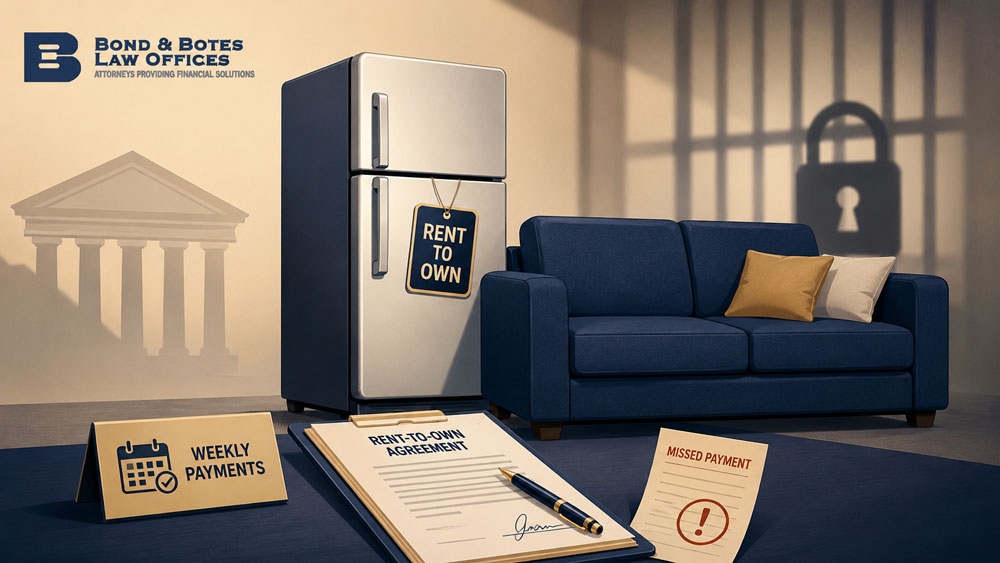
When you’re in need of a medium-ticket item like an appliance or a new couch and can’t afford to buy it outright, rent-to-own might look like the perfect solution. On the surface, it looks a lot like buying the item on credit, but it’s much more accessible to people who might not qualify for conventional financing. That’s why rent-to-own services often appeal to people with lower incomes and not-so-great credit histories. According to the Association of Professional Rental Organizations (APRO), an industry group representing rent-to-own companies, 4.63 million American households used rent-to-own services during 2024, and about 2.97 million customers had active rent-to-own agreements at any given time.
But, the deal isn’t always what consumers expect. In some cases, that’s because rent-to-own providers make misrepresentations. In April 2020, Progressive Leasing agreed to pay $175 million to settle Federal Trade Commission claims that it had misled consumers about the true price of items. Often, though, it’s simply that the rent-to-own model is poorly understood. Many consumers think of rent-to-own as financing a purchase. But the purchase, if there is one, happens at the end of the contract not at the beginning. The difference may not seem significant, but it keeps ownership in the hands of the store, and allows rent-to-own providers in many states to escape finance charge caps and other consumer protection regulations.
That means you can pay for years on a rent-to-own contract and end up with nothing if you miss a payment. In many states, including Alabama and Mississippi, it also means a missed payment plus failure to return the item after required notice can become a criminal theft issue. In Alabama, the statutory demand process may give as little as 48 hours to return property after receipt of written demand. In Mississippi, the timing depends on the statute and facts: Mississippi Code § 97-17-62 provides that failure to redeliver rental property or equipment within five days after hand delivery or return receipt can be prima facie evidence of fraudulent intent, while Mississippi Code § 97-17-64 provides that failure to return leased or rented personal property, or contact the owner to arrange return, within ten days after proper notice after the authorized term has expired can be prima facie evidence of purpose to deprive.
How Rent-to-Own Works
When you obtain an item from a rent-to-own store, you get the item delivered right away, but pay on a weekly, bi-weekly, or monthly basis. That seems just like a car loan or other finance agreement. But, when you finance a car, you own that car right away. The lender holds a lien, and can repossess the car if you don’t keep up your end of the bargain. But, you’re building up equity in the car as you make your payments. There’s a legal process required to repossess and sell the vehicle, and if it sells for more than you owe, you get that extra money.
With a rent-to-own contract, none of those things happen. You’re just renting the item, unless and until you reach the full contract price. That means you could pay $1300 dollars toward a $1500 item, and then miss a payment and lose the item. Under the terms of the contract, all those payments you made were just rental payments. And, chances are good the item was actually worth far less than the $1300 dollars in payments you made.
Rent-to-Own Pricing
Of course, buying an item over time is always more expensive than paying cash. But, the rent-to-own industry takes that to an extreme.
For example, when this article was first published in 2020, one rent-to-own provider in Mobile, Alabama offered a certain refrigerator for $19.99/week. If your refrigerator is broken and you don’t have the cash to quickly buy one or access to credit, that may seem like a great deal. But, the payments for the refrigerator stretch for 91 weeks. That’s a year and nine months of weekly payments, at the end of which you’ll have paid $1819.09 for your refrigerator.
That provider, like many others, offered a “same as cash” deal if you made your payments within six months. So, if you’re just in a short-term cash crunch and can pay quickly, you’ll save quite a bit of money. The “same as cash” deal takes the cost of the refrigerator down to $1099.00. So, if you can pay just shy of $200/month, you can save $720 dollars.
Unfortunately, many people in the rent-to-own market can’t take advantage of “same as cash” offers by rent-to-own providers. That’s especially true in a city like Mobile, Alabama, where the U.S. Census Bureau reports that 18.4% of residents are living in poverty and per capita income was $33,935 for 2020-2024. Publicly available completion-rate data is limited, but longstanding consumer research has found that many rent-to-own agreements do not end in purchase of the item.
But, is successful completion of the rent-to-own contract really a win for the customer? Of course, spending $1819.09 and ending up with a refrigerator is better than spending $1600 dollars and losing the refrigerator. Still, the cost of acquiring the refrigerator can be far out of proportion to its value. In this 2020 example--based on actual pricing from a Mobile rent-to-own provider at that time--the consumer paid an extra $720 for the privilege of making payments across 91 weeks rather than 26 weeks. But the bad deal doesn’t end there.
That’s because the “same as cash” price of $1099 was still quite a bit more than the same item might have cost if the customer paid cash somewhere else. At the time, we looked at other options for purchasing this same item in Mobile and found prices ranging from $608 to $729. Using the highest retail price we found and the “same as cash” price from the rent-to-own provider, the rent-to-own customer paid a 50.7% mark-up. The full weekly rental price across 91 weeks was almost exactly triple the lowest local retail price we found. Current prices change frequently, so consumers should compare today’s cash price, early-purchase price, total payment amount, fees, and return terms before signing a rent-to-own agreement.
But Wait...It Gets Worse
In the scenarios above, the rent-to-own customer either buys an overpriced item over time or rents that item at an inflated weekly, bi-weekly, or monthly price and ultimately loses it after missing a payment. Those outcomes range from very expensive and less than perfect to pretty awful. But, we’ve only scratched the surface of the possible consequences of a rent-to-own agreement gone bad.
In 2019, the National Consumer Law Center (NCLC) published a report on the criminalization of breach of rent-to-own contracts. In most U.S. states, including Alabama and Mississippi, because the store retains ownership until the contract is paid in full, a missed payment coupled with failure to return the item after the required notice can be treated as theft of rental property.
In particular, the Alabama Criminal Code §13A-8-140 makes it a crime to enter into a rental contract and obtain the property “with the intent, knowledge or expectation that he will not perform the terms, covenants and agreements of the lessee provided in such rental contract.”
Standing alone, that seems reasonable. But, the next section creates a presumption of intent if:
The rental contract provides for the return of the leased property to a particular place, at a particular time, and the lessee shall fail to return the leased property to the place and within the time specified in the said rental contract, and the lessor thereafter makes written demand for the return of the leased property to the place specified in the rental contract within 48 hours from the time the written demand is delivered to the lessee, and the lessee fails to return said property to the lessor within the said 48 hour period
In practical terms, that means that, under Alabama law, a renter who misses a payment may have as little as 48 hours from receipt of a written demand to return the item. If the customer misses that deadline, criminal intent is presumed. Later return of the item is generally not sufficient to disprove intent. The harsh nature of the law and the burden of proof being shifted to the consumer is no accident or oversight. The rent-to-own industry has lobbied for laws like this across the country; APRO’s 2025 industry reporting states that the U.S. rent-to-own sector generates approximately $11.8 billion in annual revenue and serves millions of American households each year.
In Alabama, the crime is a misdemeanor if the value of the item is $500 or less. But, if the value exceeds $500, the charge is a Class C felony. That means a possible prison sentence of up to 10 years and a fine of up to $15,000 for failing to return that overpriced refrigerator within 48 hours.
Rent-to-own companies can hold the threat of criminal prosecution over the renter’s head, pushing them to make payments they cannot afford in order to salvage the contract and escape criminal charges. It’s an extreme and far more effective version of the high-pressure tactics creditors and debt collectors use across industries.
But, it isn’t just a threat. The NCLC report referenced above includes numerous examples of people around the country who were actually arrested in connection with rent-to-own contracts. One man was arrested on his way to work, another couple was arrested while in the process of filing bankruptcy, and a third woman was arrested at home in front of her children for missing a payment. A registered nurse reported concern about losing her license after she was charged with a felony when she missed a month’s payment on a rented laptop. One district attorney office in Texas pursued over 400 cases during the period from 2014 through the first half of 2017 for rental theft crimes. And news reports from around the country tell similar unfortunate tales of people being arrested for missing their rent-to-own payments.
What to Know Before You Rent to Own
Rent-to-own purchases are typically much, much more expensive than one may think. Even financing an item at a relatively high-interest rate is often cheaper than renting to own. Rent-to-own contracts also escape some state interest rate caps and some consumer protection statutes, leaving renters more vulnerable than those using credit. And, in most states, breaching a rent-to-own contract could land you in jail.
In short, rent-to-own is a very bad deal financially and a riskier way for consumers to obtain goods. If you must use rent-to-own, make sure that you understand the terms clearly, and know the risks of missing a payment. Read your contract and any notices you receive from the store carefully. Be aware that if you can’t make a payment on time, you may not have the buffer you do with most creditors, and you’ll need to act quickly to resolve any problems that arise. As this article points out, the old adage Buyer Beware is especially true with rent-to-own contracts. If you find yourself struggling financially and need help, call our office today to see what we can do for you.
Frequently Asked Questions About Rent-to-Own Agreements
Is rent-to-own the same as buying something on credit?
No. With a traditional credit purchase, you usually own the item right away while the lender keeps a security interest or lien. With a rent-to-own agreement, the store typically keeps ownership unless and until you complete the required payments or exercise a purchase option under the contract.
Can I lose a rent-to-own item after making many payments?
Yes. Under many rent-to-own contracts, your payments are treated as rental payments until you complete the contract or purchase the item. If you miss a payment and do not cure the default or return the item as required, you may lose the item even after paying a large amount toward it.
Why can rent-to-own cost more than buying the item outright?
Rent-to-own agreements often allow consumers to make small weekly, bi-weekly, or monthly payments, but the total amount paid over time may be much higher than the cash price of the same item. Before signing, compare the cash price, early purchase option, total payment amount, fees, and return terms.
Can missing a rent-to-own payment lead to criminal charges in Alabama or Mississippi?
It can, depending on the facts and the state law involved. Because the store may still own the property during the rental period, missing a payment and failing to return the item after proper notice may expose a renter to allegations involving theft of rental property or fraudulent leasing/rental conduct.
What should I do if I cannot make a rent-to-own payment?
Read the contract and any notice from the store carefully, because the deadline to return the property or resolve the missed payment may be short. Do not ignore written demands, and consider speaking with a bankruptcy or consumer debt attorney if you are struggling with payments or facing threats of legal action.
Can bankruptcy help if I am behind on rent-to-own payments?
Bankruptcy may help address broader debt problems, but rent-to-own agreements can involve special issues because the item may still belong to the store. A bankruptcy attorney can review the agreement, explain your options, and help you understand how bankruptcy may affect the contract and any collection activity.
This post is intended for general information only and does not constitute legal advice. To discuss your specific situation, we encourage you to schedule a confidential consultation with an attorney.