 1-877-581-3396


Can AI Cost You Your Job? The Growing Financial Risk for Workers in Alabama and Mississippi
Submitted by the Bond & Botes Law Offices - Wednesday, June 3, 2026
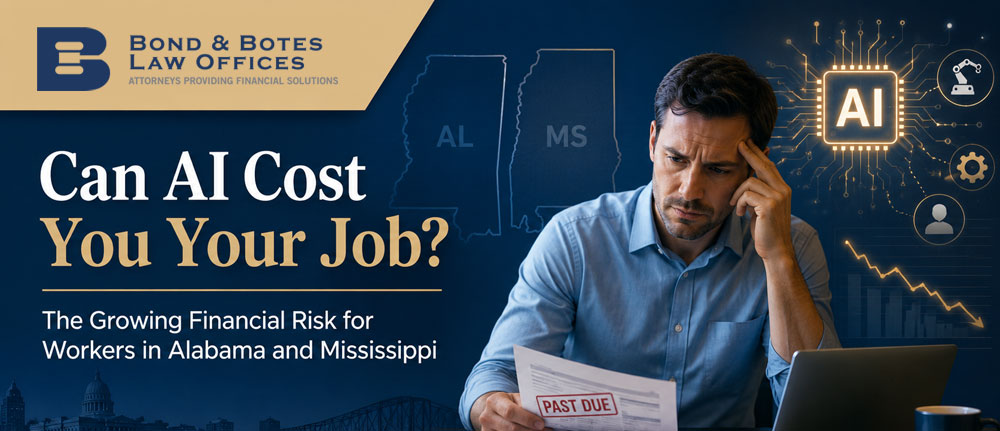
Artificial Intelligence ("AI") seems to be everywhere these days. It writes emails, answers customer service questions, creates images, reviews contracts, and even helps doctors diagnose illnesses. Some people see AI as an exciting technological breakthrough. Others see it as a threat.
If you are working in Alabama or Mississippi, there is a good chance that AI will affect your job in some way over the next few years. The question is not whether AI is coming. It is already here. The real question is whether it will make your job easier—or make your job disappear.
While economists and politicians debate the long-term impact of AI, many workers are asking a much more immediate question:
What happens if AI costs me my paycheck?
AI Is Changing Jobs Faster Than Many People Realize
Not long ago, most people assumed that automation would primarily affect factory workers. Today, AI is beginning to impact office workers, customer service representatives, paralegals, accountants, insurance adjusters, data entry personnel, marketing professionals, and even some computer programmers.
Businesses are constantly looking for ways to reduce costs and improve efficiency. If software can perform the work of three employees in a fraction of the time, some employers will inevitably choose technology over labor.
That does not necessarily mean that millions of jobs will disappear overnight. More likely, many companies will simply hire fewer people as positions become vacant. Others may reduce staff or shift responsibilities to employees who are able to work alongside AI tools.
For workers already living paycheck to paycheck, even a temporary job loss can create serious financial problems.
Alabama and Mississippi Families Are Especially Vulnerable
Many families throughout Alabama and Mississippi are already dealing with rising costs.
Groceries cost more than they did just a few years ago. Insurance premiums continue to rise. Utility bills are higher. Vehicle repairs are more expensive. Interest rates remain elevated compared to recent years.
Meanwhile, many households are carrying significant amounts of:
- Credit card debt
- Personal loans
- Medical bills
- Car loans
- Student loans
- Mortgage debt
When a family is already struggling to keep up with monthly expenses, the loss of a job—even for a few months—can create a financial crisis.
A missed paycheck can quickly become:
- Missed credit card payments
- Collection calls
- Lawsuits
- Wage garnishments
- Vehicle repossessions
- Foreclosure proceedings
Unfortunately, we see this happen every day.
The Hidden Danger: Using Credit Cards to Survive
One of the most common mistakes we see is people trying to "borrow their way through" a financial emergency.
When someone loses a job, they often turn to credit cards to cover necessities such as food, gas, utilities, and medical expenses. At first, it may seem like a temporary solution.
The problem is that credit card balances can grow rapidly, especially when interest rates exceed 25% or 30%.
By the time a person finds new employment, they may be carrying tens of thousands of dollars in debt that is impossible to repay.
What began as a temporary job interruption can become a long-term financial burden.
Bankruptcy Is Often a Tool for Recovery, Not Failure
Many people view bankruptcy as a last resort. In reality, bankruptcy laws were designed to help honest people recover from financial setbacks and get a fresh start.
Job loss, illness, divorce, business failure, and economic changes have always been common reasons people seek bankruptcy protection.
The possibility that AI may eliminate or reduce certain jobs is simply another example of a financial challenge that may be beyond an individual's control.
Depending on the circumstances, a Chapter 7 or Chapter 13 bankruptcy may help stop:
It may also allow families to eliminate or reorganize debt and regain control of their finances.
What Should You Do If You Are Concerned About AI and Job Security?
If you are worried about how AI may affect your industry, now is a good time to evaluate your financial situation.
Ask yourself:
- Do I have emergency savings?
- How much credit card debt am I carrying?
- Could I make my mortgage payment if I lost my job for three months?
- Am I relying on credit cards to cover basic living expenses?
- Do I have a realistic plan if my income decreases?
The earlier you identify potential problems, the more options you will have.
Final Thoughts
Nobody knows exactly how AI will reshape the economy over the next decade. Some jobs will disappear. New jobs will be created. Many jobs will simply change.
What we do know is that financial stress often follows periods of economic disruption.
If AI, automation, layoffs, or other economic changes leave you struggling with debt, it is important to understand that options may be available.
For more than 35 years, the Bond & Botes Law Offices has helped people throughout Alabama and Mississippi evaluate their financial options and find practical solutions to overwhelming debt.
If you are experiencing financial difficulties, we encourage you to speak with an experienced attorney about your situation.
Phone: 877-581-3396
Email: Click Here to email us through our website
Website: https://www.bondnbotes.com/
This post is intended for general information only and does not constitute legal advice. To discuss your specific situation, we encourage you to schedule a confidential consultation with an attorney.